
Cured right, built to last
Concrete Contractor in Tinley Park, IL for Slabs That Cure Strong
Driveways, patios, walks, stamped concrete and foundations for homes in Tinley Park, Orland Park, Oak Forest and Mokena, kept damp and protected while they cure so the top stays hard instead of flaking.
Built into every pour
Moist cure, every slab
Blankets or a misting hose on the new slab so it hardens slowly and evenly.
Base you can stand on
Dug to depth and compacted in lifts before a single form goes in.
Joints where they belong
Control joints laid out on purpose, cut deep enough to do their job.
Price on paper
Every line itemized, so a competing bid can be held up against ours point for point.
Yard left tidy
Boards stripped, rubble trucked away, soil raked in against the new edges.
What Can We Pour at Your Place?
Most calls start with one slab and turn into a plan for two or three. Here is the full list of work we take on, so you can picture where your project lands before we talk it over.
Concrete Flatwork
Pads for sheds and air conditioners, aprons, side slabs and any plain concrete that sits at grade. Each one is pitched to shed water and given time to cure before it carries weight.
Concrete Foundations
Footings, walls and slabs for a room addition, a detached garage or a new porch. Dug below frost depth where the plan calls for it, reinforced and poured to the drawings.
Stamped Concrete
Tinted slabs printed with slate, flagstone, brick or barnwood texture. A sealer goes on last so the tone stays rich and the texture stays crisp.
Concrete Walkways & Sidewalks
The path from driveway to porch, the strip along the garage to the back gate and the public-style walk out front, all given a slight tilt so water leaves.
Concrete Patios
A slab sized for the grill, the table and the chairs you actually own. Broom, smooth or stamped, always pitched away from the foundation of the house.
Concrete Driveways
The tired drive comes out in chunks, a fresh stone bed is rolled in, and the new slab is sized for the pickup or minivan you actually own.
Commercial Concrete
Storefront walks, trash enclosure slabs and rear lot concrete for small businesses and landlords, phased so tenants and shoppers still get through.
How Does a Job Go From First Call to Finished Slab?
You describe the job
Describe the old concrete, the size you are picturing and whether cars, a shed or just feet will sit on it. That is usually enough to sketch out an approach together.
Tape measure on site
A crew lead comes out to measure, check where water runs, look at access for the truck and see what shape the old concrete is in. Nothing gets priced from a satellite photo.
You get the price in writing
Thickness, base depth, reinforcement, finish, tear-out and haul-away each get a line. If two approaches make sense, you see both side by side and pick.
Prep, pour and finish
Old concrete comes out, the base is compacted, forms are set to grade and the pour happens on a day the forecast allows. Then the finish goes on: broom, smooth or stamp, with joints sawn before the slab gets hard.
Cure, then clean up
The new slab is covered or kept damp while it hardens, and we tell you when it can take foot traffic and when it can take a car. Forms come out, the edges are backfilled and the yard is raked clean.
Why Does Our Concrete Stay Hard Year After Year?
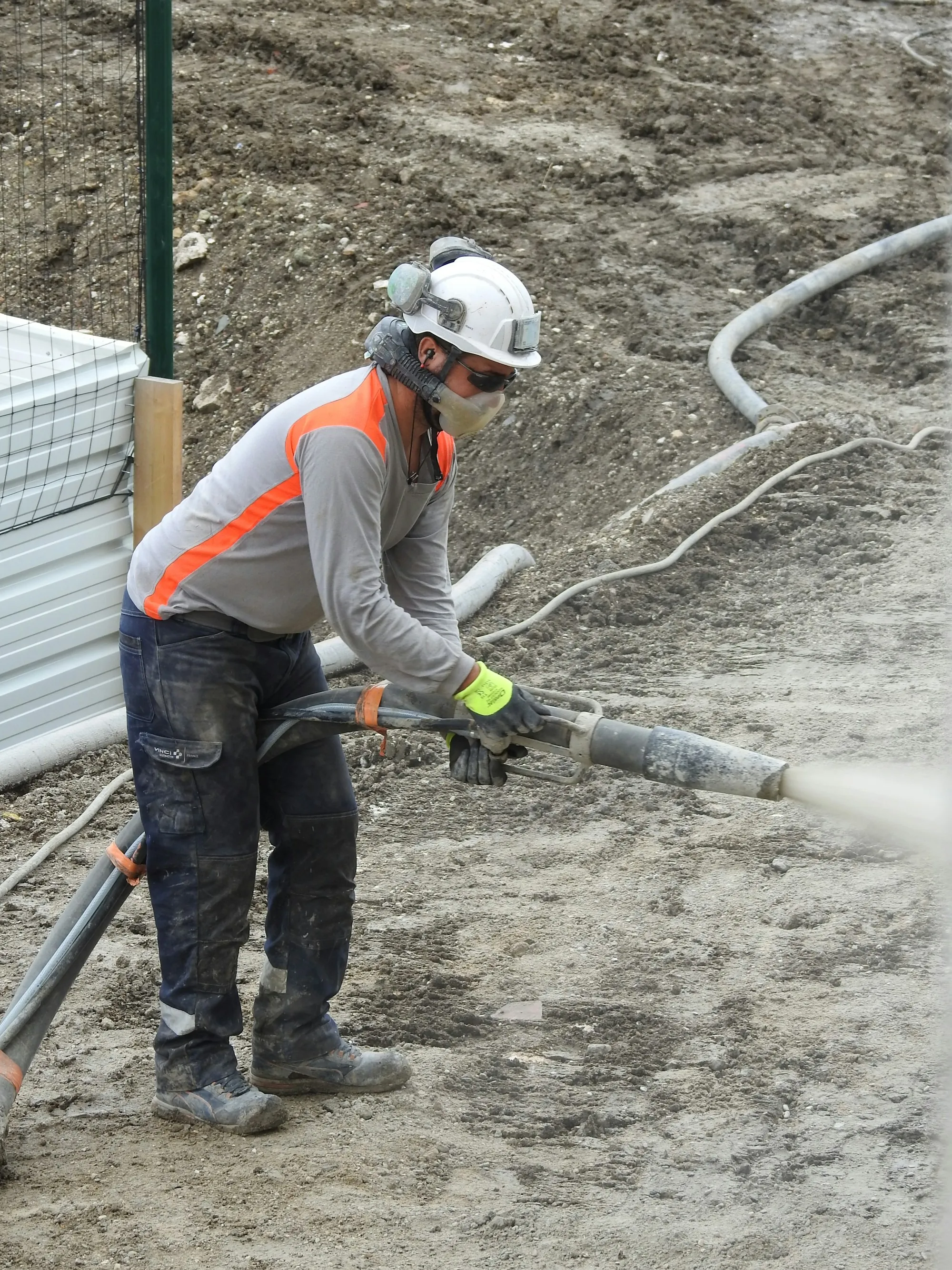
The surface you walk on is only as good as what sits under it and how it was treated in its first week. We have been pouring around here since 2017, and these habits are why our slabs hold up.
The base gets the most attention
Soft clay under a slab is the quiet reason most driveways sink and split. We dig to the right depth, bring in stone and compact it in layers until it stops moving. It is the part nobody sees, so it is the part we refuse to rush.
Decorative work with a careful hand
Stamped concrete only looks like stone if the pattern lines up, the color is even and the release is worked in by someone who has done it many times. We match the pattern and tone to your siding and brick so the patio looks like it belongs to the house.
Cracks told where to go
All concrete shrinks as it dries. Control joints spaced on purpose and cut deep enough give that shrinkage a straight line to follow, so the slab breaks along a seam you planned instead of across the middle.
One written price, every line explained
You see how thick the slab will be, how deep the base goes, what reinforcement is in it, what finish it gets and what removal costs. No vague lump sum, and no surprise charges once the trucks show up.
Pouring in Tinley Park and Next Door
Tinley Park stretches from the older blocks near Oak Park Avenue out to the newer subdivisions toward Harlem Avenue and Interstate 80, and the concrete we replace tells that story: tired driveways poured a generation ago next to builder-grade patios that were poured thin. We work across all of it, and in the towns that border it, from Oak Forest and Orland Park to Mokena, Palos Heights and Crestwood. The clay soils and hard freeze-thaw winters on the south side are the same everywhere we go, which is why base depth and curing never change from town to town.
Older lots, newer lots
A cracked driveway on a mature street and a sinking builder patio in a newer subdivision need different fixes. We look at what failed before deciding what goes in.
Soil that moves
Heavy clay swells when wet and shrinks when dry. Proper stone base and drainage keep that movement from showing up in your slab.
One number, every town
Orland Hills, Midlothian, Palos Park or Alsip, (815) 205-1713 gets you the same crew and the same way of working.
Towns on our pour list
- Tinley ParkOak Park Avenue & 159th StreetHome base
- Oak ForestCicero Avenue & 159th Street
- Orland Hills159th Street
- Orland ParkLa Grange Road
- MokenaInterstate 80
- CrestwoodCicero Avenue
- Midlothian147th Street
- Palos HeightsHarlem Avenue
- Palos ParkSouthwest Highway
- AlsipCicero Avenue
- Robbins135th Street
Live just past these towns on the southwest side? Ask us. If the trucks can reach you, we can usually take the job.
See if your block is on our route: (815) 205-1713Want a Slab That Still Looks Sharp in Ten Winters?
Flaking, dusting and scaling almost always trace back to a rushed cure. Ask us how we protect a fresh pour, and what that means for the price of your driveway or patio.
Ask about curing and pricing: (815) 205-1713One conversation, no commitment on the call.
What Do Homeowners Ask Before a Pour?
These come up on almost every call. Short, honest answers below.
What are those cut lines in a slab, and why do they matter?
They are control joints, shallow grooves that create a weak line on purpose. As concrete dries and shrinks it has to crack somewhere, and a joint cut about a quarter of the slab's depth gives it a neat place to do so. Spaced correctly, they keep cracks out of the open field of the slab where they look bad and let water in.
Why does concrete crack, and can you stop it from happening?
Concrete cracks because it shrinks as it cures and because the ground under it moves with moisture and frost. Nobody can honestly promise a slab without a single hairline, but a compacted base, the right thickness, well-placed joints and a slow, damp cure keep cracking small and in the places it was planned for.
Will a stamped patio get slick when it rains?
Any sealed surface is a little slicker when wet than plain broomed concrete. We handle that by choosing a pattern with real texture and mixing a fine grit into the sealer on walking areas, which gives shoes something to grip without changing how the patio looks.
How long will a new foundation hold up?
A poured foundation built on undisturbed soil, below frost depth, with proper reinforcement and drainage around it, should outlast the structure it carries. Problems usually come from water that is allowed to collect against the wall or from footings set too shallow, and both are things we plan for before the pour.
When people say flatwork, what do they mean?
Flatwork is any concrete that lies flat at ground level instead of standing up as a wall. Driveways, patios, sidewalks, pads and aprons all count. The craft is in the grading, the base and the finish, because a flat slab has to shed water while looking level to the eye.
Does road salt eat into new concrete?
It can, especially in the first winter. Salt draws water into the surface, and when that water freezes it pops off thin flakes. A proper air-entrained mix and a full cure help a lot, and we suggest skipping rock salt on a new slab for its first season and using sand for traction instead.
What happens to my grass and flower beds while you work?
We plan the route for the truck and the wheelbarrows before the pour so we cross as little lawn as possible, and we lay boards where equipment has to roll over grass. When the forms come out we backfill the edges with soil so the yard meets the new slab cleanly. Plants right against the work area are worth moving ahead of time.
What goes into the price of a concrete driveway?
Size is the obvious one, but thickness, how deep the base needs to go, whether there is old concrete to break out and haul away, reinforcement and the finish all move the number. Access matters too, since a pump costs more than a straight chute. We price it after measuring, with each of those items on its own line.
How thick should my driveway or patio be?
Walks and patios are usually poured about 4 inches thick. Driveways that carry cars do better at around 5 inches, and heavier trucks or RVs call for more. The base underneath matters as much as the slab itself, so we size both together for what will sit on top.
A Tinley Park Concrete Crew That Takes Its Time Where It Counts
Concrete Contractor Tinley Park is run like a trade shop, not a sales office. The person who prices your job knows how deep the base should go and why the slab needs a damp week before it sees a tire. That practical knowledge is what goes into every driveway, patio, walk and footing we pour.
Read how we work

Ready to Talk Through Your Concrete?
Describe the old slab and the new one you are picturing. In one conversation we cover depth, stone, surface and season, then pick a day to come measure.
Serving Tinley Park and the neighboring southwest suburbs.